
The distinction between mouth-to-lung and direct-to-lung vaping is the single most technically important concept in understanding how vaping hardware works, yet it is rarely explained with the precision that allows a newcomer to apply it when choosing equipment. Most guides describe MTL as similar to a cigarette draw and DTL as involving breathing vapour directly into the lungs — accurate but leaving the underlying mechanics unexplained. Those mechanics determine coil selection, wattage setting, liquid choice, and ultimately the nicotine satisfaction you get from the device.
This guide covers the complete technical picture: what the two styles involve mechanically, how airflow and coil resistance create different experiences, which devices belong to which category, and how to identify your preference before committing to hardware.
The Mechanics of Mouth-to-Lung Vaping
Mouth-to-lung vaping replicates the inhalation technique of cigarette smoking. The process is two-stage: you draw vapour into the mouth, hold it briefly, and then inhale it from the mouth into the lungs as a distinct second step — the same pattern as taking a drag from a cigarette. The key physical feature of MTL hardware is restricted airflow. The air channel through an MTL device or tank is deliberately narrow, creating resistance when you draw. This slows draw speed and concentrates the vapour in a smaller volume, producing a warm, dense draw that delivers nicotine effectively at modest vapour volumes per draw.
MTL devices operate at low wattages, typically eight to twenty watts, and use coils with resistance of one ohm or above. High-resistance coils heat to lower temperatures and produce less vapour per unit time. This matches the restricted airflow design: a small amount of dense, warm vapour moves through a narrow channel, held briefly in the mouth before inhalation. Nicotine delivery is efficient despite modest vapour volume because concentration is high and oral mucosal absorption during mouth-hold is meaningful.
Nic salt e-liquids at ten to twenty milligrams per millilitre are specifically formulated for MTL devices. The smooth delivery of salt nicotine at high concentrations, without the harshness that freebase produces at equivalent levels, suits the tight, warm draw of an MTL setup. This combination produces nicotine satisfaction that closely approximates a cigarette for most users.
The Mechanics of Direct-to-Lung Vaping
Direct-to-lung vaping uses a single inhalation action: the vapour travels in one continuous movement from mouthpiece through the mouth directly into the lungs. There is no mouth-hold intermediate step. The technique is more similar to normal breathing than to cigarette smoking.
DTL hardware achieves this through wide, open airflow design. The air channel is large, draw resistance is minimal, and it is possible to take a long, slow, full-lung draw without effort. This allows a large volume of vapour to be inhaled per draw — far more than an MTL setup produces — which is why sub-ohm vaping is associated with substantial visible vapour clouds on exhalation.
Coil resistance in DTL setups is below one ohm — hence the alternative name sub-ohm vaping — and wattages used are substantially higher, typically twenty-five to eighty watts for standard commercial coil heads. Low-resistance coils at high wattage generate significantly more heat, vaporising liquid faster and producing more aerosol per second of firing time. This large vapour volume necessitates low nicotine concentrations: three to six milligrams per millilitre of freebase nicotine in high-VG liquid is the standard choice, with large volume compensating for low concentration.
Airflow: The Design Variable That Determines Everything
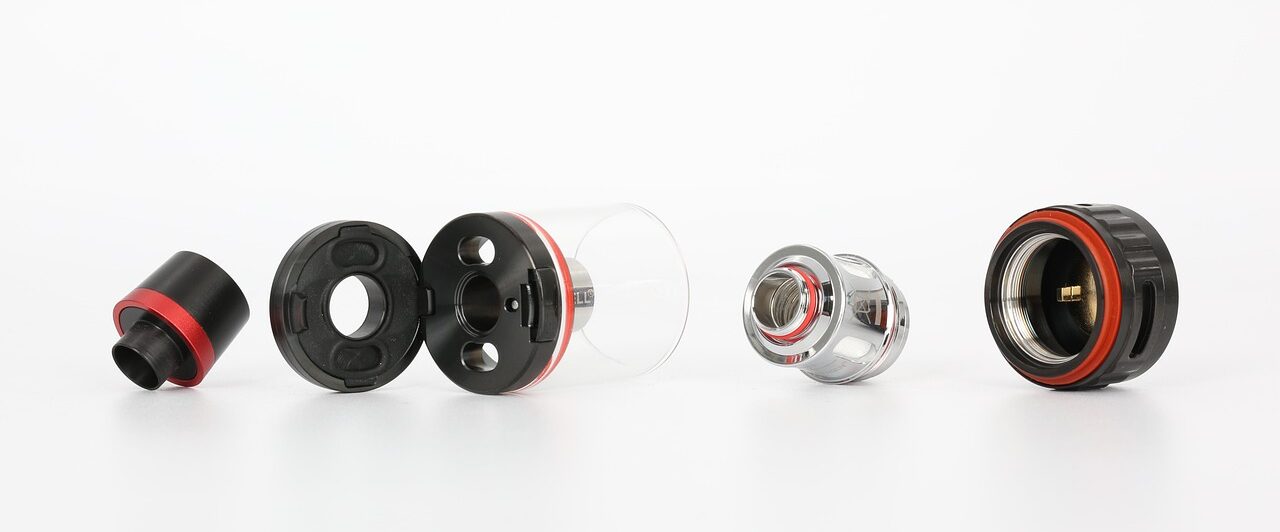
Airflow is the primary engineering decision defining whether a device or tank is MTL or DTL. Tanks designed for MTL use have fine air intake holes — sometimes a single hole of one to one point five millimetres diameter — creating meaningful resistance. DTL tanks have wide, multiple intake holes, often in a ring around the base, allowing unrestricted airflow.
Many tanks allow the user to adjust airflow within a range by rotating a ring that opens or closes intake vents. Fully open, these tanks behave as DTL devices; fully closed, they approximate an MTL experience. This adjustability is useful for vapers who want to experiment across both styles, though the coil resistance and wattage setting still need to correspond to the chosen airflow position.
The mouthpiece bore is a secondary airflow variable often overlooked. A narrow mouthpiece creates additional restriction at the final air path stage. Most MTL tanks come with a narrow mouthpiece; replacing it with a wider bore aftermarket tip noticeably opens the draw. Most DTL tanks use wide-bore mouthpieces that accommodate large vapour volume without restriction.
Coil Resistance and Its Consequences
Coil resistance — measured in ohms and printed on the coil head packaging — is both a consequence of design intent and a practical guide to wattage range. Above-ohm coils (one ohm and higher) are designed for MTL use and operate safely at lower wattages. Standard values in commercial MTL coil heads are one point two, one point four, one point six, and one point eight ohms. At these resistances, coil temperature is moderate and liquid vaporisation rate is slow, matching the narrow airflow design.
Sub-ohm coils (below one ohm) are designed for DTL use and draw more current, requiring higher wattage. Common values in commercial sub-ohm heads are zero point one five, zero point two, zero point three, and zero point six ohms. At the wattages required to operate within specification — often thirty to seventy-five watts — coil temperature is high and vaporisation rate fast, producing the dense clouds associated with DTL vaping.
Mismatching coil resistance to device wattage produces predictable problems in both directions. Running a sub-ohm coil at low wattage produces insufficient heat, resulting in weak flavour, poor vapour production, and wet gurgling draws. Running a high-resistance MTL coil at sub-ohm wattages burns the cotton immediately and produces an intensely unpleasant burnt taste from the first draw.
Matching Liquid to Draw Style
High-VG liquids at seventy percent or above are too viscous to wick through the fine cotton channels of MTL coil heads and produce dry hits and coil damage in MTL devices. Standard DTL shortfill liquids formulated for sub-ohm coils are physically incompatible with MTL hardware. This is not a preference matter — it is a physical necessity.
Conversely, high-concentration nic salt liquids in a DTL device would deliver a harmful dose of nicotine per draw given the large vapour volume. Twenty milligrams per millilitre in a fifty-watt DTL device is not viable. The low concentrations used in DTL liquids are a safety feature of the format, not a compromise.
Fifty-fifty liquids are the most versatile option for users who use different devices for different situations. They wick adequately in MTL coils and perform reasonably in sub-ohm coils, though they do not deliver the full cloud production of high-VG shortfills in DTL setups.
If you are coming to vaping from cigarette smoking, MTL is almost certainly your natural starting point. The draw resistance is familiar, the nicotine delivery at high nic salt concentrations is closer to the cigarette pharmacokinetic profile, and the device format — compact, discreet, simple — matches the function of a cigarette in your daily routine. DTL vaping suits users who have progressed past the initial switching stage and whose nicotine needs have reduced to the point where three to six milligrams satisfies them.